FOLLOW ME.......... T.Q

DAN HARI MALAYSIA UCAPAN IKLAS DARI 9W2PHJ/PRPHJ

Sabtu, 12 November 2011

FEEDING 7 BILLION AND OUR FRAGILE ENVIRONMEND


This image taken by NASA's Aqua satellite in 2008 shows the state of Arctic sea ice. Mankind's immense pressure on the planet is causing the fastest extinction of species in millions of years and is rapidly heating up the planet, threatening more extreme weather.

According to projections by the United Nations, the world population has reached 7 billion and continues to grow rapidly. While more people are living longer and healthier lives, gaps are widening between the rich and the poor in some nations and tens of millions of people are vulnerable to food and water shortages. There is, of course, the issue of the impact of that sheer number on the environment, including pollution, waste disposal, use of natural resources and food production. This post focuses on wheat and the effect of our numbers on the environment. Wheat is the most important cereal in the world and along with rice and corn accounts for about 73 percent of all cereal production. It isn't surprising that 7 billion people have a lasting impact on our world's natural resources and the environment in which we live.

A male polar bear carries the head of a polar bear cub it killed and cannibalized in an area about 300 km (186 miles) north of the Canadian town of Churchill in 2009. Food supplies for polar bears are being affected by rising temperatures and melting ice.

One of the world's breadbaskets lies in the prairies of Canada. This stalk, near Lethbridge, Alberta, helps form the foundation for the most important food product in the world: cereal grains.


Massive grain elevators hold wheat before it is transferred onto railway cars in Carseland, Alberta.

Grain inspector Jim Dolan inspects wheat from the Canadian prairies at the Pioneer grain elevator in Carseland, Alberta. For decades, the world's focus has been more on distributing food aid, including excess grains, to poor nations. Over the last few years, that focus has shifted toward better positioning poor farmers to feed themselves, according to Reuters.

A display case in the quality control room at the Alliance Grain Terminal in Vancouver, British Columbia. With the stumbling economy hindering government efforts to boost production and distribution, such private groups as the Bill and Melinda Gates Foundation and the Rockefeller Foundation are becoming more involved in agricultural research and development.

Rail cars loaded with Canadian wheat travel through the Rocky Mountains on the Canadian Pacific railway line near Banff, Alberta.

Wheat is harvested in Alberta this fall. The United Nations predicts the world's population will grow to about 9 billion by 2050. With no increase in arable land expected, a collection of private foundations, government agencies, and the United Nations are seeking ways to boost production in such crops as wheat.

A farmer takes water from a dying pond to irrigate his vegetable field on the outskirts of Yingtan in China.

A worker removes dead fish from a lake in Wuhan, central China's Hubei province, in 2007. Mankind's immense pressure on the planet is causing the fastest extinction of species in millions of years and is rapidly heating up the planet, threatening more extreme weather, according to scientists.

A Hindu devotee wraps a piece of clothing around himself after a ritual dip in the polluted Yamuna river in New Delhi in 2010. The United Nations warns that the problems of pollution, deforestation, and climate change are expected to worsen as the world's population climbs.

A boy swims in the polluted waters of Manila Bay in the Philippines in 2010. "Manila Bay has become a huge floating dump for the whole of metro Manila,'' said one Greenpeace worker.

A cargo ship plies the Strait of Georgia off Vancouver, British Columbia. Grain exports from Canada and the United States are pieces of the puzzle on how the world is going to feed its growing population. "We are talking about adding 2.6 billion people between now and 2050. That is two Chinas," Robert Thompson, former director of rural development for the World Bank, told Reuters. "We have to raise productivity. I think we can do it all if we invest enough in research. But at the moment we aren't."

Pigeons and dust cloud a street in Kuwait City in 2008. The world's mean temperatures continue to rise, say UN scientists

Two youths frolic at a beach in Qingdao, Shandong province, in China. The resort city has been the site of large algae blooms.

A garbage collector carries a sack as he walks atop a massive pile of garbage at the Bloemendhal dump in central Colombo in 2009.

Steam billows from the cooling towers of Vattenfall's Jaenschwalde brown coal power station on a lake near Cottbus, eastern Germany in 2009.

Oil is burned off the surface of the water near the source of the Deepwater Horizon spill in the Gulf of Mexico off the coast of Louisiana last summer. The US government estimates that 206 million gallons of oil were released by BP's well a mile beneath the sea. Tens of billions of dollars have been spent or committed by BP on cleaning up the devastation and compensating victims.

A laborer takes a break from his work at a brick factory at Togga village on the outskirts of the northern Indian city of Chandigarh in 2009.

The Haibowan coal-fired power plant on the outskirts of Wuhai in China's northern Inner Mongolia region in 2009.


A man works at the site of a rare earth metals mine at Nancheng county, Jiangxi province in 2010.

Khamis, 10 November 2011

AFGHANNISTAN OCTOBER 2011


Shafiyah, 27, released from prison after three years in jail, poses for a portrait at a shelter run by women for Afghan women in Kabul on October 12, 2011. Shafiyah was arrested and imprisoned after fleeing her Taliban husband who became destitute after the Taliban was ousted. Women's rights in Afghanistan risk being forgotten as international troops withdraw, reports by Oxfam and ActionAid said.

With a per capita GDP of $900, Afghanistan ranks as one of the world's ten poorest countries. By any measure, challenges are numerous. Aid agencies observe an erosion of women's rights as foreign troops prepare to leave, the infant mortality rate is among the world's highest, and despite eradication efforts, 90 percent of the world's opium is still produced by Afghan farmers. Meanwhile, military fatalities approach 2800 since the war began in 2001. Civilians are afforded no such precision for their casualties, with varying estimates in the tens of thousands being the only accounting. Gathered here are images from the country made in October of the lives of women and children, daily life, and consequences of the conflict in Afghanistan and in the United States.


Muttahara Mohammed, 5, attends a class on how to read verses of the Quran in a mosque in Kabul on October 26, 2011.

An Afghan child lies on the ground next to a woman begging for money in a street in Kabul on October 23, 2011.

A burqa-clad Afghan woman holds her baby as she walks in the outskirts of Herat on October 25, 2011

Girls attend a class at a camp for the displaced in Kabul on October 11, 2011. Women's rights have improved in Afghanistan since the Taliban were ousted, but recent Oxfam data shows women's personal safety, opportunity, and human rights inside the nation are beginning to erode back to conditions that existed previously. Under the Taliban, girls schools had been closed, women were banned from working outside the home, and forced to wear the burqa.

People visit a cemetery outside the Sakhi shrine in Kabul on October 24, 2011.

The Qala Iktyaruddin Citadel in Herat that dates back to Alexander the Great has been restored, a bright sign of progress in a country destroyed by war. The citadel and a new museum was completed by hundreds of local craftsmen with funding and support from the U.S. and German governments and the Aga Khan Trust for Culture.

Boys sit on a grave at a cemetery in Kabul on October 17, 2011.

Laborers have breakfast in their quarters at a coal dump site outside Kabul on October 18, 2011. Each laborer earns ten dollars on an average working day. Most of them come from the northern provinces, leaving their families behind in search of fortune in the capital.

Women walk in a market in Kabul on October 26, 2011.

US soldiers fly on a military plane across Afghanistan on October 8, 2011.

Afghanis look at the site of an explosion in a fuel truck in Parwan province on October 26, 2011. A bomb hidden inside exploded as scores of people gathered to collect fuel that was leaking, killing at least five.

A man mourns his brother, who was killed in a fuel tanker blast in Parwan province on October 26, 2011.

A security man checks the wreckage of a civilian car which was hit by a roadside bomb in Nangarhar province on October 28, 2011, killing two men, a woman and a child.

Aziz Ahmad, 25, who believes he has mental problems, is chained to a wall during his 40-day incarceration at the Mia Ali Baba Shrine in Jalalabad on October 11, 2011. It is believed that 40 days in chains and a diet of bread and water at the 300-year old shrine can cure mentally ill people. Ahmad was chained by the shrine keeper at the request of his family.

A severely wounded US Marine hit by an improvised explosive device is carried by his comrades to a helicopter on October 31, 2011. The Marine lost both his legs and fights for his life.

Donna and Dennis Elm (left) cry during the funeral of their son, Army Spc. Michael Elm, 25, of Phoenix, Ariz., at Arlington National Cemetery in Arlington, Va. on October 31, 2011. Insurgents attacked his unit in Khowst with an improvised explosive device.

A woman watches the casket of Army Pvt. Danny Chen placed in a hearse in Chinatown on October 13, 2011 in New York. Pvt. Chen, who had been in Afghanistan for two months, was found dead with a gunshot wound below his chin. While preliminary signs suggest Pvt. Chen killed himself, the Army told the soldier's parents he was subjected to taunting and violence by some of the soldiers with whom he served.

The body of Army Spc. Steven E. Gutowski, who died in Afghanistan after an improvised explosive device attack, is carried out of St. Peter's Church in Plymouth following his funeral on October 17, 2011.

An Afghan policeman reacts as a U.S. helicopter lands at the site of a suicide attack in Kabul October 29, 2011. At least four people were killed when a suicide car bomber attacked a convoy of foreign soldiers.

Selasa, 8 November 2011

THE HAJJ AND EID AL-ADHA 1432 H/2011


The Mecca CLock Tower dominates the city as Muslim pilgrims walking around the Kaaba in the Grand Mosque of the holy city of Mecca during the annual Hajj pilgrimage rituals on November 7, 2011.


The Hajj pilgrimage draws millions of Muslims from around the world every year to Mecca, the birthplace of the Prophet Muhammad, Islam's holiest place. Saudi Arabia expects to host perhaps three million people in a ritual journey that every able-bodied Muslim who can afford it must make at least once in their lifetime. It is the largest annual gathering of humanity anywhere. Timed to the Muslim lunar calendar, the Hajj is followed by the celebrations of the three-day festival of Eid al-Adha, or the Feast of Sacrifice, which symbolizes Abraham's willingness to sacrifice his son. Collected here are photographs of the Hajj in Mecca, Saudi Arabia, as well as images of preparations for the Hajj and Eid al-Adha in many other parts of the Muslim world.

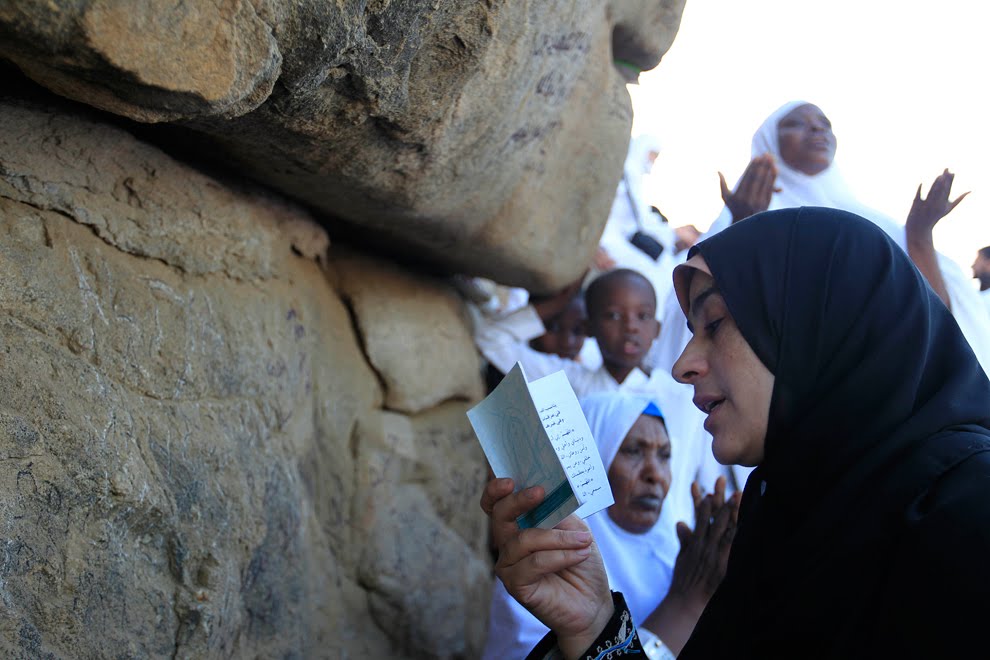
A Muslim pilgrim prays as visits the Hiraa cave at the top of Noor Mountain on the outskirts of Mecca, Saudi Arabia on November 2, 2011. According to tradition, Islam's Prophet Mohammed received his first message to preach Islam while he was praying in the cave.

Tens of thousands of Muslim pilgrims move around the Kaaba (center) inside the Grand Mosque in Mecca, Saudi Arabia on November 3, 2011.

Tens of thousands of Muslim pilgrims pray inside the Grand Mosque in Mecca, Saudi Arabia on November 4, 2011.

Muslim pilgrims wait in line as they arrive at Jeddah airport on October 30, 2011 before going to the Saudi holy city of Mecca, where they will take part in the annual Hajj or pilgrimage.

Muslim pilgrims climb a rocky hill called the Mountain of Mercy on the Plain of Arafat near Mecca, Saudi Arabia on November 5, 2011

Birds fly over Muslim pilgrims near the Grand Mosque in the Saudi holy city of Mecca on November 3, 2011.

Muslim pilgrims pray on a rocky hill called the Mountain of Mercy on the Plain of Arafat near Mecca, Saudi Arabia on November 5, 2011.

Thousands of Muslim pilgrims arrive to throw pebbles at pillars during the "Jamarat" ritual, the stoning of Satan, in Mina near the holy city of Mecca, on November 6, 2011.

A Saudi police officer monitors screens connected to cameras set up at all the holy places in Mina near the Saudi holy city of Mecca, Saudi Arabia on November 7, 2011.

Tens of thousands of Muslim pilgrims move around the Kaaba (center) inside the Grand Mosque in Mecca, Saudi Arabia on November 3, 2011.

Hajj pilgrims cry as they prepare to depart for Mecca from the Tribhuvan International Airport in Kathmandu on October 18, 2011.

Thai Muslim pilgrims offer prayers before they depart for the annual Hajj pilgrimage to Mecca at the Hat Yai International airport in southern Thailand on October 5, 2011.

Indonesian pilgrims conduct a practice run of a religious ritual before a mock-up of the Kabaa, Islam's holy shrine, at a training center in Jakarta as part of final preparations before departing for the hajj pilgrimage in Mecca on October 28, 2011. For the world's largest Muslim-majority country with more than 200,000 pilgrims each year, the training is crucial in preventing chaos and casualty in the holy land, officials say.

Yemenis shop at a market in Sanaa on November 3, 2011, in preparation for the Eid al-Adha feast, or Feast of Sacrifice, which marks the end of the annual hajj pilgrimage for Muslims worldwide.

Pakistani traders wait for customers to sell their livestock for the upcoming Eid-al-Adha festival in a market in Islamabad, Pakistan on November 4, 2011.

Tents of Muslim pilgrims recede into the distance at Mina, Saudi Arabia on November 7, 2011.

A Muslim boy attends a prayer session in celebration of the Eid al-Adha festival inside the Golden Mosque in Manila on November 6, 2011.

Russian Muslims pray outside St. Petersburg's mosque during the first day of the Eid al-Adha (Kurban Bairam) on November 6, 2011.

A Yemeni soldier who defected greets a fellow Muslim after attending prayers on the first day of Eid al-Adha prayers in Sanaa on November 6, 2011.

Bangladeshi passengers sit on the roof of a train as they head to their homes to celebrate Eid al-Adha on the outskirts of Dhaka, Bangladesh on November 6, 2011.

A man carries a sacrificial goat on sale at a market, ahead of the Eid al-Adha feast, in Sanaa, Yemen on November 5, 2011.

Anti-Khadafy fighters visit the graves of their friends during Eid al-Adha celebrations in Benghazi, Libya on November 6, 2011.

Muslims buy sheep in a bazaar in Linxia, in China's Gansu Province on November 6, 2011. Muslims in northwest China celebrated their traditional feast of Corban Festival, or Eid al-Adha, meaning "Feast of Sacrifice" Sunday.

Iranian Sunni Muslim men try to slaughter a camel on Eid al-Adha in Siminshahr, in a Sunni area of Iran, a country which is predominantly Shiite, on November 7, 2011.

A young Indian Muslim boy smiles with a sacrificial goat on Eid-al-Adha in Allahabad, India on November 7, 2011.

Muslim women attend prayer on the slopes of Mount Merapi (in the background) to celebrate the festival of Eid al-Adha in the village of Kalitengah Lor outside city of Yogyakarta, Central Java on November 6, 2011.